
RadiXplore's Work in Saudi Arabia: An Update Following FMF 2026
Using our 'Ghosts in the Machine' AI workflow, we successfully mapped 150 years of exploration history in Saudi Arabia, revealing new insights from legacy data at FMF 2026.
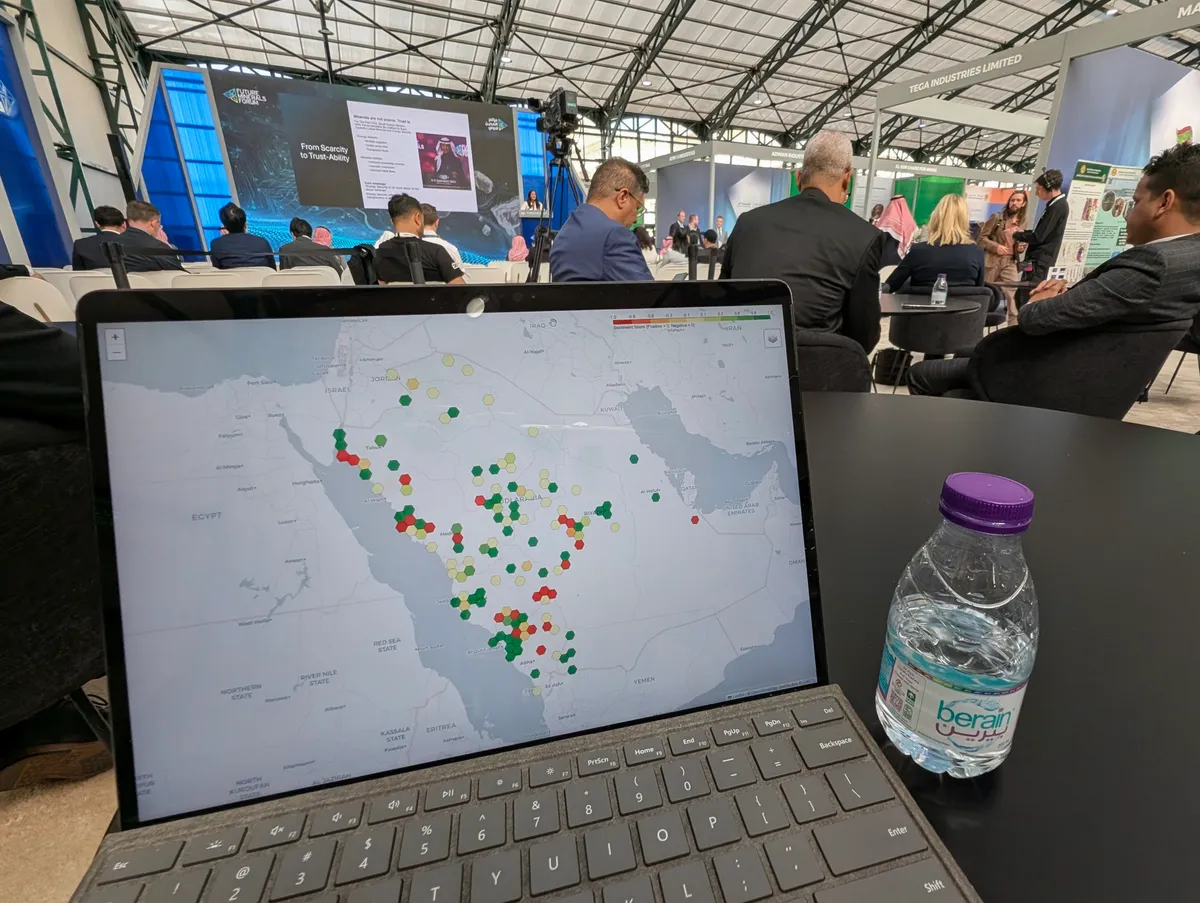
One year ago, during Future Minerals Forum 2025, RadiXplore ran its first AI-based searches over Saudi Arabia’s national geological data as an exploratory step. The focus then was simple: could large volumes of legacy geological text be made searchable and interpretable in a way that preserved geological meaning?
Twelve months later, returning to FMF 2026, that question has evolved into something far more concrete.
Over the past year, RadiXplore has been developing and validating a new AI-enabled exploration synthesis workflow - internally referred to as “Ghosts in the Machine” - designed to systematically revisit historical exploration near-misses and orphaned results at national scale. FMF 2026 marked the first time this workflow was applied comprehensively to Saudi Arabia’s NGD bibliographic data.
From documents to decisions
Saudi Arabia’s NGD contains decades of exploration reports, drilling summaries, and technical observations spanning multiple commodities and geological eras. Much of this information has historically been difficult to synthesise because it exists primarily as unstructured text rather than structured databases.
The Ghosts in the Machine workflow is designed to address that gap.
Rather than focusing solely on occurrences or intercepts, the approach extracts outcomes and intent from historical exploration programs - capturing where drilling consistently succeeded, where it repeatedly failed, and where results were ambiguous but geologically informative. In effect, it treats historical reports as a record of exploration decisions, not just data points.
At FMF 2026, RadiXplore generated its first Saudi-wide “Ghosts in the Machine” map, condensing approximately 150 years of precious- and base-metal drilling activity into a single interpretive layer derived directly from NGD bibliographic reports.
This is not a prospectivity map in the conventional sense. Instead, it represents a form of collective exploration memory - preserved in text and made readable at scale through AI-assisted synthesis.
Early patterns emerging
When filtered by commodity focus, the resulting patterns begin to diverge from traditional exploration narratives. For base metals, the synthesis highlights:
- Distinct metallogenic provinces that reflect consistent historical outcomes rather than isolated results.
- High-risk, high-reward rift-related belts where exploration outcomes were mixed but persistent.
- Southern districts where repeated work has effectively de-risked certain system types.
- Frontier areas under cover where historical programs may have been limited by the models of their time.
A particularly interesting signal emerging from this work is the presence of areas historically explored almost exclusively for gold that exhibit textual indicators consistent with untested porphyry-style systems. These are not presented as targets, but as questions that were never fully asked under earlier exploration paradigms.
FMF as a validation point
FMF 2026 served as an important checkpoint for this work. Discussions with exploration teams, service providers, and national stakeholders consistently converged on a shared challenge: how to prioritise drilling and capital deployment more deliberately when historical data is abundant but fragmented.
The reception to the Ghosts in the Machine framework reflected that need. The emphasis on synthesis, near-misses, and decision context - rather than automated target generation - resonated strongly with both technical and strategic audiences.
The broader interest was reflected externally as well. A LinkedIn post outlining the conceptual basis of this work and its Saudi application generated over 100,000 impressions, accompanied by extensive technical discussion among geologists and industry practitioners. While not a measure of technical success in itself, the engagement underscored the relevance of the problem being addressed.
What comes next
Following FMF 2026, RadiXplore’s work in Saudi Arabia is now moving into its next phase. This includes:
- Extending the Ghosts in the Machine workflow across additional commodities, including critical minerals.
- Expanding synthesis beyond individual datasets to integrate regional geochemistry and multi-commodity context.
- Refining how historical uncertainty and ambiguity are represented, rather than smoothed away.
- Continuing engagement with operators and national stakeholders to align the methodology with real-world decision processes.
Saudi Arabia remains a long-term focus for RadiXplore, not as a single project but as a jurisdiction where national-scale geological data, exploration ambition, and modern analytical approaches intersect.
As this work progresses, further technical detail will be shared in dedicated publications. For now, FMF 2026 marked a clear transition: from exploring whether historical geological text could be analysed at scale, to demonstrating how it can meaningfully inform the next generation of exploration decisions.