
Finding Orphaned Uranium Deposits in Western Australia Using AI‑Powered Geological Search

Introduction - Why Orphaned Uranium Matters in Western Australia
Western Australia hosts some of the world's most prospective uranium systems, particularly palaeochannel‑ and calcrete‑hosted deposits formed in arid, near‑surface environments. Yet many of these systems remain unexplored - not because they lack geological potential, but because uranium was historically treated as an incidental commodity.
During the 1970s-1990s, uranium frequently appeared in exploration programs targeting gold, base metals, or iron ore. Radiometric anomalies were logged, assays were occasionally reported, and then - in many cases - the data was quietly archived when commodity prices, company strategy, or regulatory hurdles shifted focus elsewhere.
These abandoned or deprioritised prospects are what we refer to as orphaned or blind uranium deposits: uranium occurrences that were detected, documented, and then forgotten - not invalidated by geology, but sidelined by circumstance.
The challenge today is not a lack of data. Western Australia's WAMEX archive contains decades of exploration reports. The real problem is that this data is unstructured, fragmented, and difficult to interrogate systematically.
This case study documents how RadiXplore was used to:
Identify orphaned uranium occurrences in Western Australia, and in the process uncover a 20‑year reporting error that shaped exploration decisions across multiple companies.
The Challenge - Uranium Hidden in Unstructured Exploration Data
Uranium exploration presents a unique data problem.
Unlike commodities that were consistently pursued as primary targets, uranium often appears in historical reports as:
- incidental radiometric readings
- qualitative descriptions such as "uraniferous"
- background assay tables
- conclusions stating "no further work undertaken"
These signals are rarely captured in report titles or commodity lists. As a result, traditional keyword searches and manual reviews struggle to surface them - especially across thousands of reports.
WAMEX is an extraordinary archive, but it was never designed for pattern‑based discovery across time, geography, and reporting language.
This is precisely the gap RadiXplore was built to address.
How RadiXplore Identifies Orphaned Uranium Deposits
RadiXplore integrates the full WAMEX archive into a single searchable environment, combining:
- full‑text report indexing
- structured metadata
- spatial context
- advanced query logic
At the core of this workflow is Nerd Search - RadiXplore's advanced query system designed specifically for geological investigation.
What Is Nerd Search?
Nerd Search allows users to construct precise, syntax‑based queries that:
- apply Boolean logic and proximity matching
- search inside report text, abstracts, conclusions, and metadata
- return both documents and their spatial locations
Rather than asking "Which reports mention uranium?", Nerd Search allows you to ask:
"Where was uranium observed, in the right geological setting, and then abandoned for non‑geological reasons?"
Read here for more details on NerdSearch
 Russell Menezes
The Uranium Query - Filtering for Geological Opportunity, Not Noise
To identify orphaned uranium deposits, the following Nerd Search query was constructed:
(uranium | uraniferous | U3O8 | radiometric | scintillometer | eU)
+
(palaeochannel | paleochannel | calcrete | "valley fill" | drainage |
 "Tertiary sediment" | "Cenozoic sediment")
+
("no further work" | "not followed up" | "low priority" | uneconomic |
 "not economic at the time")
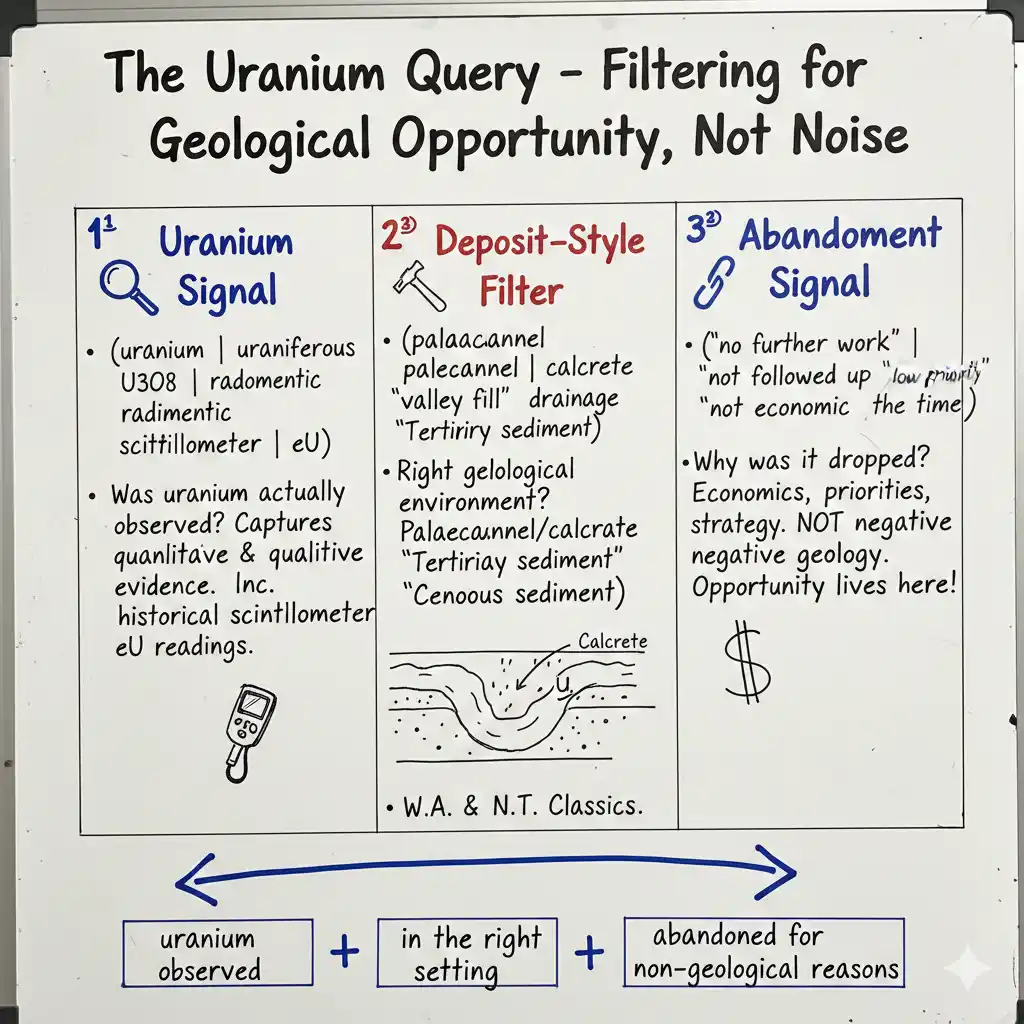
This query is deliberately restrictive. It does not simply find uranium - it isolates abandoned uranium opportunity.
1️⃣ Uranium Signal - Was uranium actually observed?
This block captures both quantitative and qualitative evidence of uranium, including radiometric detections that were never followed up with geochemistry.
Older reports often recorded uranium via scintillometer readings or equivalent uranium (eU) without systematic drilling. Excluding these signals would eliminate much of the historical evidence.
2️⃣ Deposit‑Style Filter - Is it in the right geological environment?
This block restricts results to palaeochannel‑ and calcrete‑hosted environments - the classic uranium systems of Western Australia and the Northern Territory.
This ensures the results reflect geological plausibility, not background radiation.
3️⃣ Abandonment Signal - Why was it dropped?
This block targets language commonly used in relinquishment reports when work ceased due to economics, priorities, or strategy - rather than negative geology.
This is where opportunity lives:
uranium observed → in the right setting → abandoned for non‑geological reasons
Results - A High‑Grade Uranium Signal Found in Minutes
Applying this query with spatial and temporal filters returned 222 relevant reports across Western Australia.
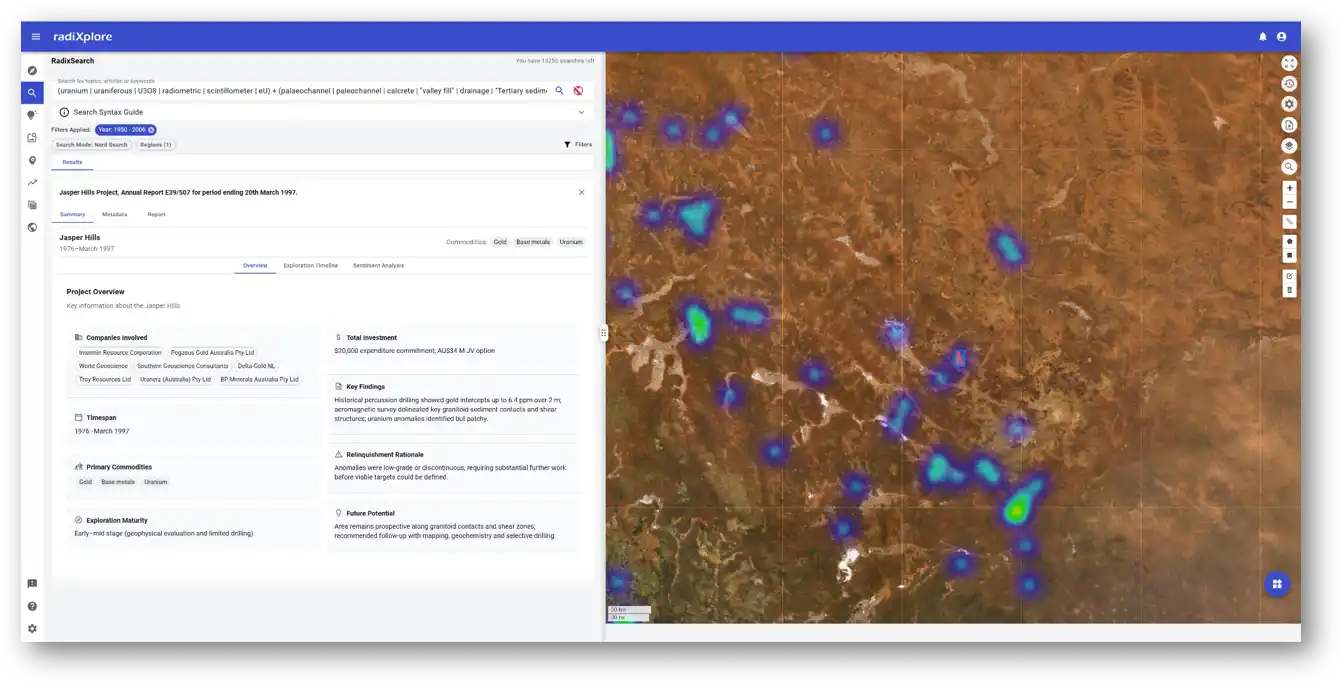
Within minutes, one report stood out.
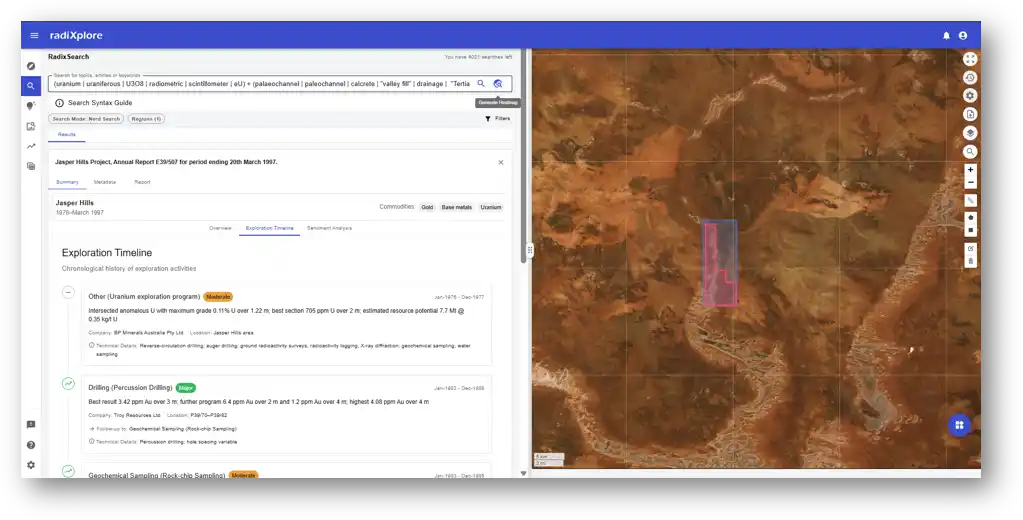
Report A51125 - Anomalous Uranium Left Behind
A51125 contained the following summary:
"Intersected anomalous uranium with maximum grade 0.11% U over 1.22 m; best section analysed 705 ppm U over 2 m; estimated resource potential 7.7 Mt @ 0.35 kg/t U."
Despite these results, the report concluded:
"Six mineral claims pegged over anomalous zone but no further work undertaken."
A baseline uranium grade of 705 ppm in a palaeochannel‑style system is not trivial. It establishes that uranium can be economically concentrated in this environment.
Time to first major lead:
- Nerd Search execution: ~5 minutes
- Review of historical summary: ~15-20 minutes
Total time: under 30 minutes
Deep Dive - 21 Years of Exploration on Tenement E39/507
To understand why no follow‑up occurred, a detailed review of the tenement history was conducted.
Using RadiXplore's spatial and metadata filters:
- Tenement: E39/507
- Commodity: Uranium (primary or mentioned)
- Spatial overlap with A51125
Eight reports were identified, spanning 1997-2018.
What the Record Shows
- Multiple operators over 21 years
- Repeated uranium mentions
- Extensive geophysics, including $774,000 invested by EAMA (2006-2010)
- No uranium‑focused drilling completed
Crucially:
Only BP Minerals reported economic‑grade uranium (705 ppm).
Without this single data point, the system would appear marginal at best. With it, the palaeochannel becomes demonstrably fertile.
The Contradiction - When the Data Didn't Add Up
While reviewing A51125 more closely, a contradiction emerged.
The same report stated:
- BP Minerals: 705 ppm U over 2 m
- Uranerz: "No anomalous results were obtained from drill samples"
This raised an obvious question:
If uranium of this grade existed, why did Uranerz find nothing?
Two possibilities existed:
- Uranium is highly patchy and Uranerz missed the mineralisation
- BP and Uranerz were not working in the same location
Resolving this required primary source verification.
The Discovery - A 20‑Year False Citation Chain
Using Nerd Search and tenement‑based filters, the original BP Minerals and Uranerz reports were located within minutes.
When both were examined spatially, the answer was immediate.
The Reality
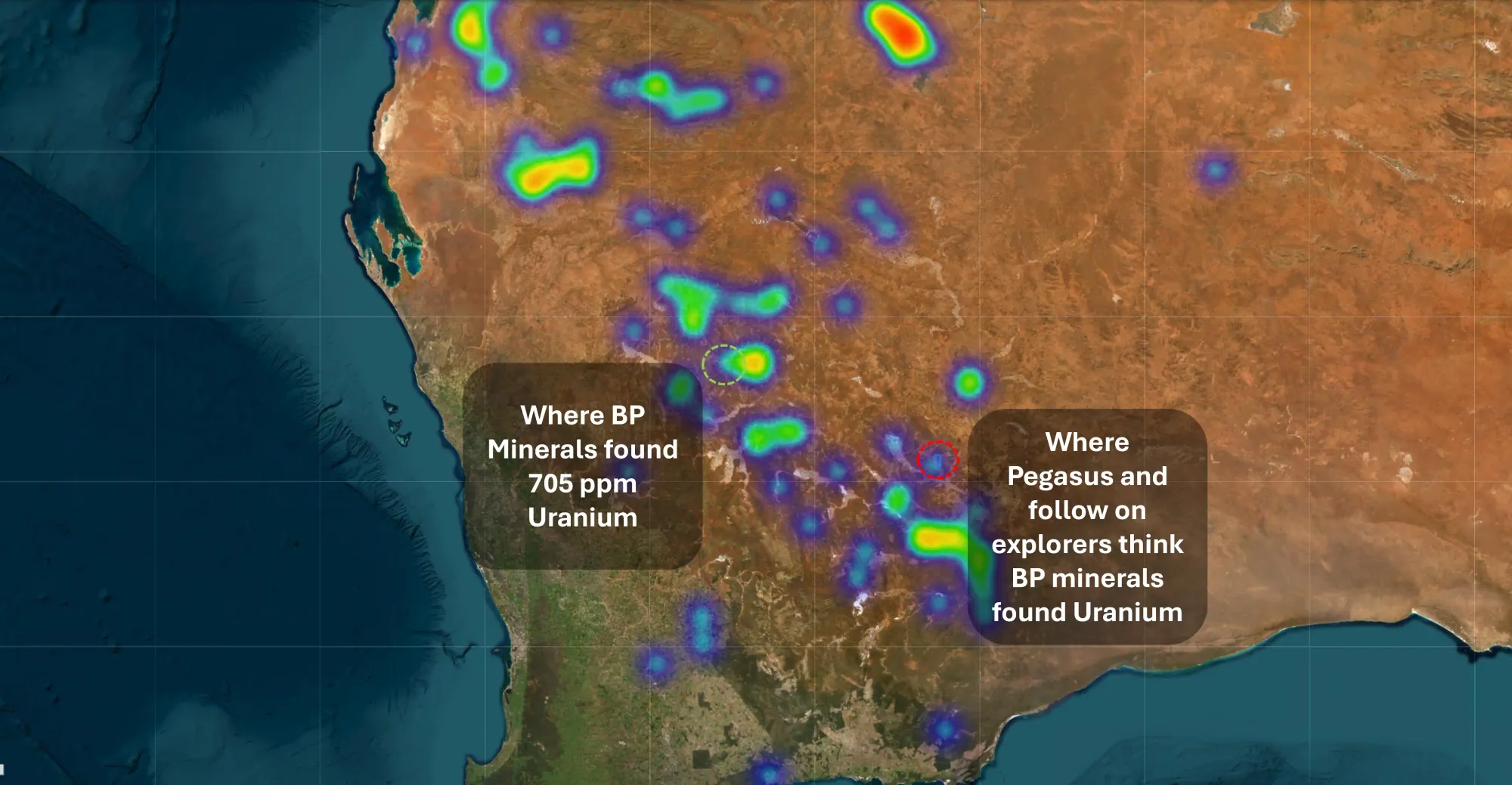
- BP Minerals worked at Lake Mason
- Uranerz and subsequent explorers worked at Lake Minigwal
- These are separate palaeochannel systems
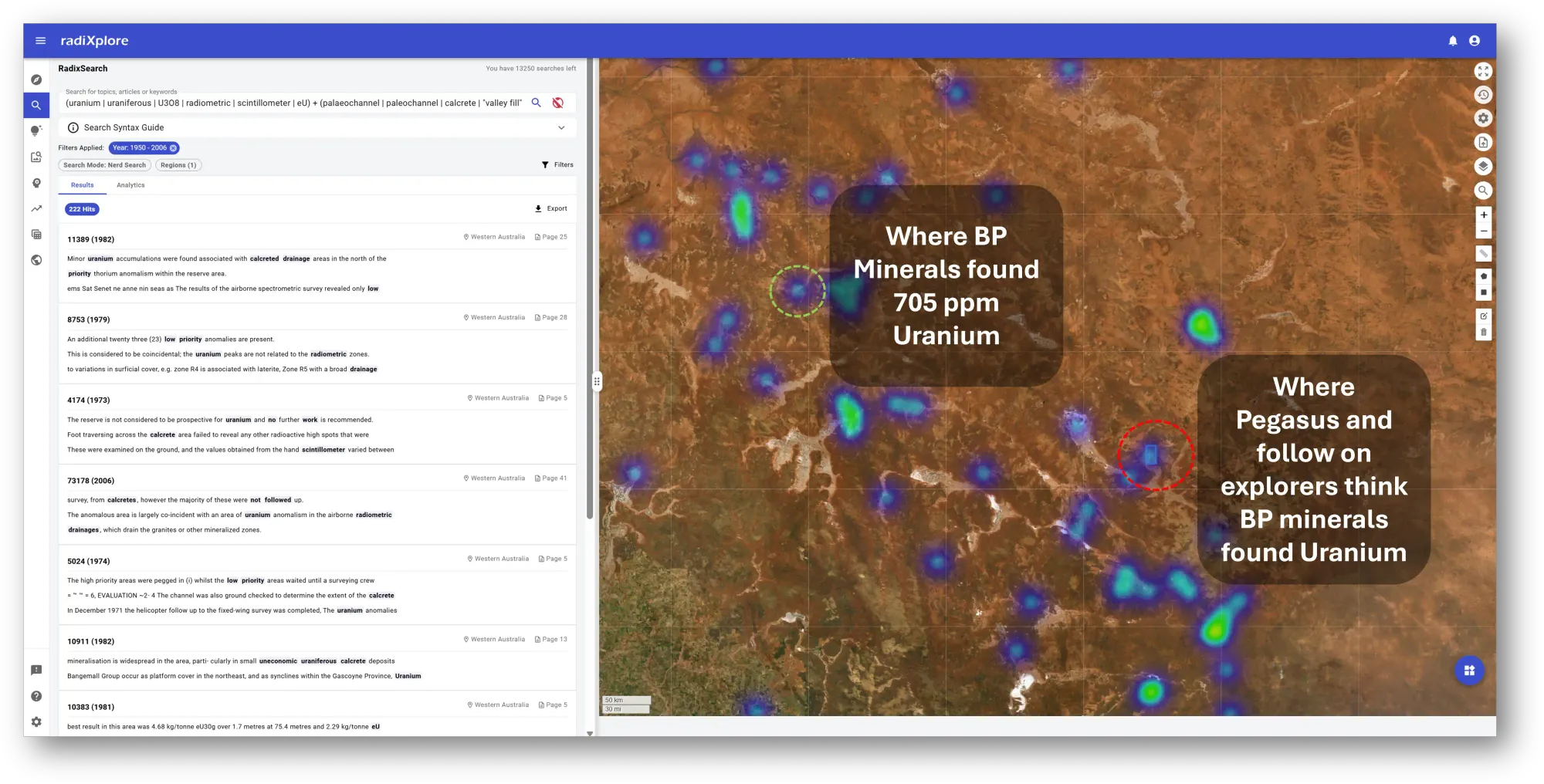
A51125 cited BP's 705 ppm result without clearly stating the location. Subsequent reports repeated the reference, assuming it applied to Lake Minigwal.
Over time, this assumption solidified into accepted baseline knowledge.
A false linkage persisted for more than 20 years.
The Impact of the Error
Based on the assumed high‑grade baseline:
- Multiple explorers pursued Lake Minigwal
- Significant capital was deployed
- Exploration strategies were shaped by a misattributed result
Notably:
- EAMA invested $774,000 between 2006-2010
- Aeromagnetic and infill surveys were completed
- Multiple POW submissions were lodged
All influenced by a uranium grade that did not belong to that system.
Why RadiXplore Made This Possible
This investigation was only possible because RadiXplore enables:
- rapid access to primary source reports
- simultaneous text and spatial validation
- verification of citations across decades
- systematic interrogation of unstructured data
What would traditionally take weeks of manual searching, GIS work, and document tracing was completed in days - with higher confidence.
Time Comparison - Manual Review vs RadiXplore
| Task | Traditional Workflow | RadiXplore |
|---|---|---|
| Locate relevant reports | Days | Minutes |
| Verify historical citations | Extremely difficult | Immediate |
| Spatial validation | Separate GIS | Built‑in |
| Total investigation time | Weeks | ~3-4 days |
Conclusion - Faster Research, Better Decisions
In four days using RadiXplore, I identified a geological reporting error that persisted for over 20 years - an error that influenced exploration strategy and spending across multiple companies.
This is the power of combining modern AI‑driven search tools with geological reasoning: faster research, and more accurate decisions.
As uranium exploration returns to focus, the ability to interrogate historical data critically - and correctly - will be just as important as new drilling.
RadiXplore was built for exactly this purpose.
Discover hidden insights in your historical exploration data.
Start your journey with RadiXplore and see what your reports might be hiding
Learn More